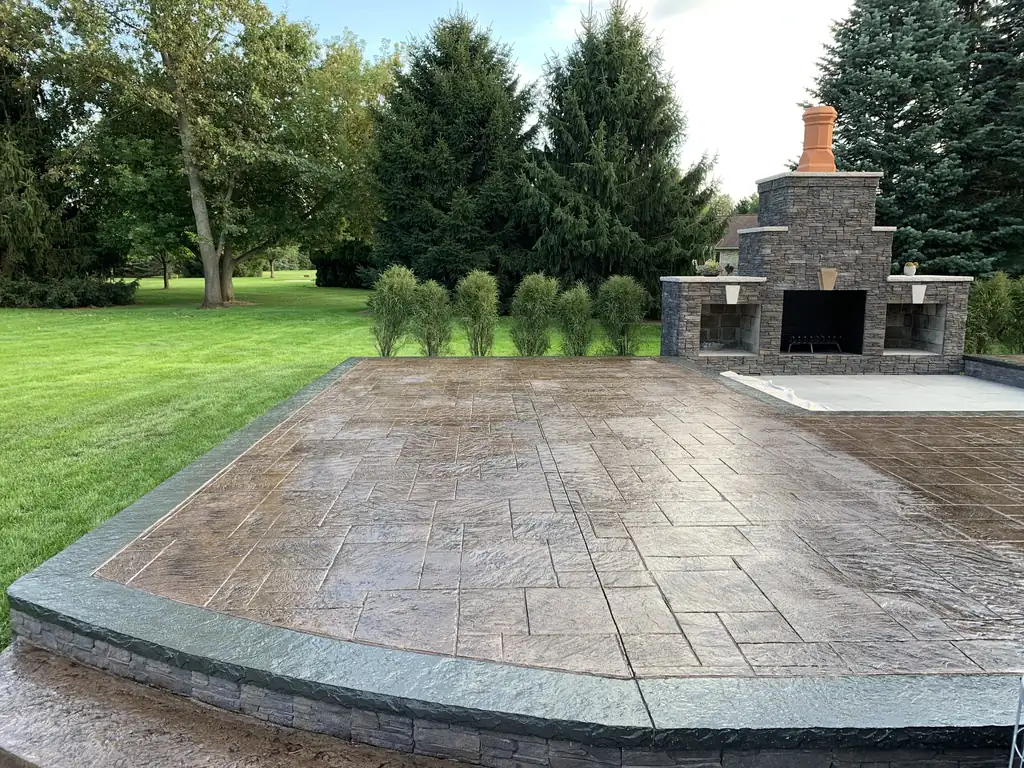
Stamped concrete gives you the look of stone, brick or wood plank in a single poured slab. Here's how it's done, what Noblesville homeowners can expect to pay, and how to keep it looking good through Indiana winters.
How stamped concrete works
A stamped concrete patio starts like any concrete slab: excavation, a compacted gravel base, forms, and usually reinforcement.
Read moreShow less: How stamped concrete works
While the concrete is still workable, the crew adds color (integral color mixed into the batch and/or a color hardener on the surface), applies a release agent, and presses large textured mats into the surface to create the pattern. After curing, joints are cut to control cracking and the surface is sealed. Timing matters. Stamping has to happen in a narrow window as the concrete sets, which is why crew experience shows in the finished product.
What it costs, by pattern
One-color brick patterns average about $9 per sq ft; custom logos and inlays run $18–$301.
Read moreShow less: What it costs, by pattern
| Style | Average cost / sq ft |
|---|---|
| Brick (1 color) | $9 |
| Slate | $11 |
| Cobblestone (multi-color) | $14 |
| Wood plank | $16 |
| Custom logo / inlay | $18–$30 |
Source: Angi, Indianapolis stamped concrete costs (2026)1. Estimates only.
By project size, Angi estimates about $900–$3,000 for 100 sq ft and $9,000–$30,000 for 1,000 sq ft1. TheFatBook models a 400 sq ft stamped patio in Indianapolis at about $6,500–$7,951, versus about $3,604–$4,407 for the same size in plain concrete3. Borders, multiple colors, steps and multi-level layouts all add cost1.
Stamped concrete vs. pavers
Neither is “better” across the board. Here's how cost, cracking, repairs and upkeep compare.
Read moreShow less: Stamped concrete vs. pavers
| Stamped concrete | Pavers | |
|---|---|---|
| Typical Indy-area cost | $9–$30/sq ft1 | $8–$24/sq ft4 |
| Surface | One continuous slab | Individual units with joints |
| Cracking | Control joints guide cracks, but slabs can still crack | Units shift instead of cracking; can be reset |
| Repairs | Patches can be hard to color-match | Replace individual pavers |
| Upkeep | Reseal every 2–3 years | Occasional joint-sand top-up; sealing optional |
Neither is “better” across the board. Stamped concrete has no joints for weeds or ants and a seamless look. Pavers are more forgiving of soil movement. Your contractor can talk through which fits your yard.
Indiana weather and stamped concrete
Covers sealing schedule; winter care; pour season; soil and base; and permits.
Read moreShow less: Indiana weather and stamped concrete
Sealing schedule
Angi recommends resealing stamped concrete every 2–3 years in Indianapolis to protect against winter moisture and freeze-thaw, at about $1–$3 per sq ft each time. Repairs for cracks, chips or color loss run about $300–$1,0001. Build resealing into your long-term budget.
Winter care
Freeze-thaw cycles are the main enemy of any concrete in central Indiana. Good drainage away from the slab, a quality sealer, and gentle cleaning products all help preserve the finish1. Ask your contractor which de-icing products, if any, they recommend for your sealed surface.
Pour season
Concrete needs reasonable temperatures to cure properly, which is why pours in central Indiana cluster from spring to fall. If you're getting quotes in winter, expect to be scheduled for spring.
Soil and base
Noblesville is in Hamilton County, where clay subgrade is common2. A well-compacted base and proper slope away from the house reduce the risk of heaving and cracking.
Permits
Permit rules in Noblesville are set by the City of Noblesville, not by Indianapolis, and they can change. The contractor you hire should confirm whether your specific project needs a permit and pull it if so. If you want to double-check, call the City of Noblesville building or planning department before work starts.
Angi notes that in Indianapolis, small patios may not need approval, but driveways or walks connecting to public property may, with fees starting around $1401. Noblesville's rules may differ.